
Employee-to-Seat Ratio: How to Calculate, Benchmark, and Optimize Your Office Space
The employee-to-seat ratio — how many employees share each physical desk or workstation — has become the defining metric of hybrid workplace strategy. Get it right, and you optimize real estate costs while maintaining a great employee experience. Get it wrong, and you either waste millions on empty desks or create a frustrating environment where people can’t find places to work.
What Is the Employee-to-Seat Ratio?
The employee-to-seat ratio expresses how many employees are assigned to each physical desk. A 1:1 ratio means every employee has a dedicated assigned desk. A 3:1 ratio means three employees share each desk, working on the assumption that not all three will be in the office simultaneously.
Before hybrid work, most offices operated or close to 1:1. Today, with hybrid schedules reducing average daily attendance to 40-60% of headcount, many organizations are experiencing ratios of 1.5:1, 2:1, or even 3:1. Understanding how occupancy sensors work is the first step toward measuring these ratios accurately.
Industry Benchmarks
Based on occupancy data from enterprise deployments — consistent with JLL’s workplace research — here are the typical ratios we see across industries:
Technology companies tend to operate at 2:1 to 3:1. Their hybrid-friendly cultures mean lower daily attendance, and their younger workforce generally adapts well to hot-desking. Financial services firms typically operate at 1.5:1 to 2:1 — regulatory requirements and trading floor density keep ratios lower. Professional services (consulting, legal, accounting) often achieve 2.5:1 to 3.5:1 because consultants spend significant time at client sites. Government and healthcare organizations remain closer to 1:1 due to security requirements and operational needs.
The Danger of Guessing
Many organizations set their seat ratio based on badge data, surveys, or HR headcount records. The problem: these proxies are systematically inaccurate.
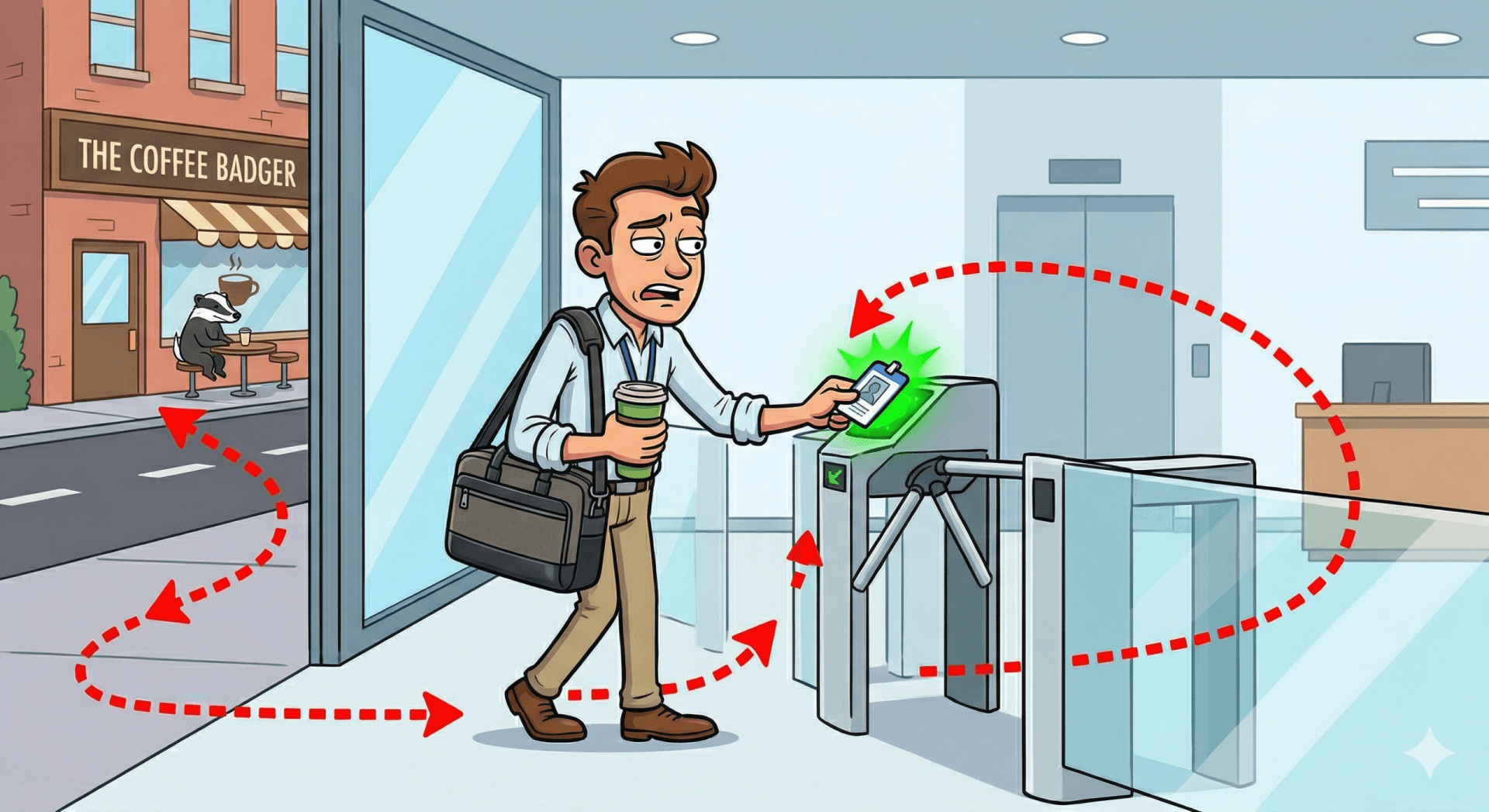
Badge data tells you who entered the building, not who sat at a desk. Someone who badges in, goes to meetings all day, and leaves never occupied a workstation. Further, employees developed the Coffee Badging model as a reaction to the Return To Office policies (RTO), where they badge-in but then step out of the building for outside coffee meetings
Surveys capture intention, not behavior. People overestimate their office attendance by 15-20% on average. Headcount data is static and doesn’t account for the significant day-to-day variation in attendance.
The result: usually organizations over-provision (wasting 20-30% of their real estate budget on empty desks) and sometimes even under-provision (creating frustrating desk shortages that drive employees away from the office).
Why Granularity Matters
Not all departments act the same. While an overall office ratio is a meaningful savings matrix, the day-to-day space management is about the behaviors and norms of each department, as represented on the space neighborhoods and floors. Employees prefer to be at the office on the same days as their colleagues they work with, for meetings and socializing, and then will utilize the desks assigned to them or the department.
How Occupancy Data Changes the Equation
Real-time occupancy sensors provide the ground truth that proxies cannot. With desk-level occupancy data from edge AI sensors, you can measure actual peak utilization (the highest percentage of desks occupied on any given day), average daily utilization (how full your floor typically is), time-of-day patterns (when desks are most and least occupied), and day-of-week variation (the difference between busy Tuesdays and quiet Fridays) and all in a granularity of neighborhood, bank of desks, types of desk and floors
This data transforms seat ratio planning from guesswork into evidence-based allocation. Instead of assuming 60% attendance, you know it’s 52% on average with a peak of 73% on Wednesdays for the sales department.
Calculating Your Optimal Ratio
The formula is straightforward: Optimal Ratio = Headcount / (Peak Utilization × Total Desks × (1 + Buffer)).
The buffer (typically 10-15%) accounts for growth, seasonal variation, and the psychological comfort of not having a completely full floor. Most workplace experts recommend maintaining at least 85-90% peak desk availability — meaning some desks should always be open even on the busiest day.
A Practical Example
Consider a company with 1,000 employees and 600 desks, current ratio of 1.67:1. Occupancy data shows peak weekly utilization of 72% (432 desks occupied) with a typical range of 45-72%. With a 10% buffer, they could potentially reduce to 475 desks (2.1:1 ratio) while maintaining comfortable availability even at peak times
At $15,000 per desk per year (fully loaded with real estate, utilities, and services), that is ~$1.8M in annual savings — discovered through confident data that badge swipes and surveys simply cannot provide.
With an accurate data system, the analysis can go one step further, identify where the spaces and departments hot desking is already optimal, where assigned seating is what needs to be tackled and which desks can be shared (pairs of existing desks that are never used at the same time)
The PointGrab Approach
PointGrab’s edge AI sensors provide the desk-level occupancy data that makes seat ratio optimization possible. Because our sensors detect actual human presence in 1-minute intervals (not devices or badges), you get the most accurate picture of how your space is actually used. And because we deliver data via open REST APIs, you can integrate it with whatever analytics or workplace management platform you prefer. For a deeper look at how this data flows through your workplace infrastructure, see The Complete Guide to Workplace Sensing Infrastructure.
Ready to discover your actual employee-to-seat ratio?
Deploy PointGrab CogniPoint sensors above the areas of interest and understand exactly how your desks are used — so you can optimize with confidence, not guesswork.
Frequently Asked Questions
What is an employee-to-seat ratio?
The employee-to-seat ratio is the number of desk spaces available per employee, commonly expressed as ratios like 1:1, 1.5:1, or 2:1.
How do you determine the right seat ratio for your organization?
The optimal ratio depends on attendance patterns, work styles, and culture. Occupancy data shows which ratios work best for different teams, neighborhood and floors.
What does a 1:1 ratio mean?
A 1:1 ratio means one desk per employee, common in organizations where employees work in-office regularly.
What’s a typical ratio for the hybrid model?
Hybrid organizations commonly use 1.5:1 to 2:1 ratios, presenting the saving derived from employee’s hybrid behavior
How can occupancy sensors validate seat ratios?
Sensors provide data on peak, mean and median occupancy and space utilization, showing whether chosen ratios actually match real office attendance patterns. See our comparison of sensor technologies to understand which approach fits your environment.
Can seat ratios be different for different teams?
Yes, different departments often have different attendance patterns and collaboration needs, supporting different optimal seat ratios. Further, these behaviors chang over time…
What happens if seat ratios are too low?
Insufficient seating creates employee frustration when they can’t find desks and might occupy a meeting room or other spaces. This is hurting office experience and reducing in-office attendance.
